


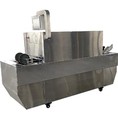


What is the Drying Capacity of the Sample Stenter Dryer per Hour?
As a supplier of Sample Stenter Dryers, I often encounter inquiries from customers about the drying capacity of our equipment per hour. Understanding the drying capacity is crucial for businesses in the textile and related industries, as it directly impacts production efficiency and cost - effectiveness. In this blog, I will delve into the factors that influence the drying capacity of a Sample Stenter Dryer and provide an in - depth analysis of how to calculate and optimize it.
Factors Affecting the Drying Capacity
The drying capacity of a Sample Stenter Dryer is not a fixed value but is affected by several key factors.
-
Material Properties
The type of material being dried plays a significant role. Different textiles have different moisture absorption rates and evaporation characteristics. For example, natural fibers like cotton tend to hold more moisture compared to synthetic fibers such as polyester. Cotton fabrics may require more energy and time to dry completely. Additionally, the thickness and density of the material also matter. Thicker and denser fabrics have a larger volume of moisture to remove, which can reduce the drying capacity per hour.

-
Initial Moisture Content
The amount of moisture present in the material before entering the dryer is a critical factor. If the initial moisture content is high, the dryer will need to work harder and longer to achieve the desired dryness. For instance, freshly washed fabrics may have a moisture content of 50% - 70%, while fabrics that have been pre - dried to some extent may have a moisture content of 10% - 20%. A higher initial moisture content will result in a lower effective drying capacity per hour. -
Temperature and Airflow
The temperature inside the dryer and the airflow rate are two interrelated factors that affect drying capacity. Higher temperatures generally increase the rate of evaporation, but there is a limit to how high the temperature can be set without damaging the material. The airflow helps to carry away the evaporated moisture from the material surface. A well - designed dryer should have an optimal combination of temperature and airflow. For example, a dryer with a high - speed airflow can quickly remove the moisture from the material, increasing the drying capacity. However, if the airflow is too strong, it may cause uneven drying or even damage the fabric. -
Dryer Design and Size
The design of the Sample Stenter Dryer, including the layout of the heating elements, the shape of the drying chamber, and the type of conveyor system, can significantly impact the drying capacity. A well - designed dryer will ensure uniform heat distribution and efficient moisture removal. The size of the dryer also matters. Larger dryers can accommodate more material at once, potentially increasing the overall drying capacity per hour. However, larger dryers also consume more energy and may require more space.
Calculating the Drying Capacity
To calculate the drying capacity of a Sample Stenter Dryer per hour, we can use the following general formula:
[Drying\ Capacity\ (kg/h)=\frac{Mass\ of\ Moisture\ Removed\ (kg)}{Drying\ Time\ (h)}]
Let's assume we have a batch of fabric with an initial mass of (M_1) kg and a final mass of (M_2) kg after drying. The mass of moisture removed is (M = M_1 - M_2) kg. If the drying process takes (t) hours, then the drying capacity (C) is given by (C=\frac{M}{t}) kg/h.
For example, if we start with 100 kg of fabric with an initial moisture content of 50% and after 2 hours of drying, the fabric has a moisture content of 10%, the initial mass of moisture is (100\times0.5 = 50) kg, and the final mass of the dry fabric is (M_2=\frac{100\times(1 - 0.5)}{1 - 0.1}\approx55.56) kg. The mass of moisture removed is (M = 100 - 55.56 = 44.44) kg. The drying capacity is (C=\frac{44.44}{2}=22.22) kg/h.
Optimizing the Drying Capacity
To increase the drying capacity of the Sample Stenter Dryer per hour, the following measures can be taken:
-
Pre - drying
Before sending the material to the dryer, pre - drying the material can significantly reduce the initial moisture content. This can be done through methods such as centrifugal spinning or air - drying. Pre - drying can increase the effective drying capacity of the dryer and reduce energy consumption. -
Proper Temperature and Airflow Settings
Regularly calibrate and adjust the temperature and airflow settings of the dryer according to the material being dried. Use sensors and control systems to maintain optimal conditions. For example, for heat - sensitive materials, a lower temperature and a higher airflow rate may be more appropriate. -
Maintenance and Cleaning
Keep the dryer in good working condition by performing regular maintenance and cleaning. A dirty or malfunctioning dryer may have reduced heat transfer efficiency and airflow, which can lower the drying capacity. Clean the filters, heating elements, and drying chambers regularly to ensure smooth operation.
Comparison with Other Drying Equipment
In the market, there are other types of drying equipment such as Lab Stenter Machine and Hot Air Drying Oven. Compared with these equipment, the Sample Stenter Dryer has its own advantages in terms of drying capacity.
The Lab Stenter Machine is mainly used for small - scale testing and sample production. It is designed to provide precise control over the drying process but may have a relatively lower drying capacity per hour compared to a full - scale Sample Stenter Dryer. The Hot Air Drying Oven is a more general - purpose drying equipment. It may not be as efficient as the Sample Stenter Dryer in terms of handling textiles, especially when it comes to continuous drying of large volumes of fabric. The Sample Stenter Dryer is specifically designed for textile drying, with features such as a conveyor system for continuous operation, which can achieve a higher drying capacity per hour.
Conclusion
The drying capacity of a Sample Stenter Dryer per hour is influenced by multiple factors, including material properties, initial moisture content, temperature, airflow, and dryer design. By understanding these factors and taking appropriate measures to optimize the drying process, businesses can increase the drying capacity and improve production efficiency.
If you are in the textile or related industries and are interested in our Sample Stenter Dryer, we welcome you to contact us for more information and to discuss your specific requirements. Our team of experts can provide you with detailed technical support and help you choose the most suitable dryer for your production needs.
References
- Textile Drying Technology Handbook.
- Principles of Industrial Drying, Second Edition.