


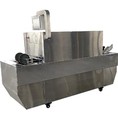


As a supplier of Horizontal Padding Mangle, I've witnessed firsthand the widespread use and benefits of this equipment in the textile industry. However, like any technology, it comes with its own set of limitations, especially when applied in large - scale systems. In this blog, I'll delve into these limitations to provide a comprehensive understanding for those considering its use in large - scale textile operations.
1. Capacity Constraints
One of the primary limitations of Horizontal Padding Mangle in large - scale systems is its capacity. In large - scale textile production, the volume of fabric that needs to be processed is immense. The Horizontal Padding Mangle, while efficient for smaller to medium - sized operations, may struggle to keep up with the high - volume demands of large factories.


The padding process involves applying a liquid (such as dye or finishing agents) to the fabric. The speed at which the mangle can operate is limited by its mechanical design. For instance, the rollers' size and the pressure they can exert are fixed. If the production line requires a large amount of fabric to be padded within a short time frame, the Horizontal Padding Mangle may become a bottleneck. This can lead to longer production cycles, increased waiting times, and ultimately, reduced overall productivity.
2. Uniformity Issues
Maintaining uniformity in large - scale systems is another significant challenge. In large - scale textile production, it is crucial that the liquid application is consistent across the entire width and length of the fabric. However, the Horizontal Padding Mangle may face difficulties in achieving this.
As the fabric passes through the mangle, factors such as uneven roller pressure, variations in fabric tension, and the viscosity of the liquid can affect the uniformity of the padding. In large - scale operations, where the fabric width can be quite large, ensuring equal pressure distribution along the entire width of the rollers becomes even more challenging. This can result in uneven dyeing or finishing, leading to quality issues in the final product. For example, some areas of the fabric may have a higher concentration of dye, while others may be under - padded, causing color variations or inconsistent finish properties.
3. Maintenance and Downtime
In large - scale systems, minimizing downtime is essential for cost - effective production. However, the Horizontal Padding Mangle requires regular maintenance, which can be a significant limitation. The mangle's mechanical components, such as the rollers, bearings, and pumps, are subject to wear and tear over time.
In a large - scale production environment, where the mangle is operating continuously, the frequency of maintenance increases. Replacing worn - out parts, cleaning the system, and performing regular inspections can take a considerable amount of time. During this maintenance period, the production line has to be shut down, resulting in lost production hours. Moreover, if a major component fails, it can lead to extended downtime, which can have a severe impact on the overall production schedule and profitability.
4. Energy Consumption
Large - scale textile production is energy - intensive, and the Horizontal Padding Mangle is no exception. The mangle requires energy to operate the rollers, pumps, and other components. In large - scale systems, where multiple mangles may be in use simultaneously, the energy consumption can be substantial.
The high energy consumption not only increases the operational costs but also has environmental implications. As energy prices continue to rise and environmental regulations become more stringent, the energy inefficiency of the Horizontal Padding Mangle can be a significant drawback. Additionally, the need for a reliable and sufficient power supply can be a challenge, especially in regions with unstable power grids.
5. Compatibility with Other Equipment
In large - scale textile production systems, the Horizontal Padding Mangle needs to be integrated with other equipment such as dyeing machines, drying ovens, and winding machines. Ensuring compatibility between the mangle and these other machines can be a complex task.
For example, the speed and tension requirements of the Horizontal Padding Mangle may not match those of the upstream or downstream equipment. If the fabric is fed into the mangle at an incorrect speed or tension, it can lead to problems such as fabric wrinkling or uneven padding. Moreover, the type of liquid used in the padding process may need to be compatible with the subsequent processing steps. If there are compatibility issues, it can result in additional processing steps or modifications to the production line, increasing costs and complexity.
6. Adaptability to Different Fabrics
Large - scale textile production often involves processing a wide variety of fabrics, each with its own unique properties. The Horizontal Padding Mangle may have limitations in its ability to adapt to different types of fabrics.
Some fabrics, such as delicate silk or stretchy elastane blends, require special handling during the padding process. The Horizontal Padding Mangle may not be able to adjust its pressure, speed, and other parameters accurately to accommodate these different fabric types. For instance, a high - pressure setting suitable for thick cotton fabrics may damage delicate silk fabrics. This lack of adaptability can limit the range of fabrics that can be processed efficiently in large - scale systems, reducing the flexibility of the production line.
7. Cost - effectiveness
When considering large - scale systems, cost - effectiveness is a crucial factor. While the Horizontal Padding Mangle is a relatively cost - effective solution for smaller operations, its cost - effectiveness may decrease in large - scale applications.
The initial investment in a Horizontal Padding Mangle can be significant, especially if multiple units are required for large - scale production. Additionally, the ongoing costs of operation, including energy consumption, maintenance, and replacement parts, can add up over time. When compared to alternative technologies or equipment that may be better suited for large - scale operations, the Horizontal Padding Mangle may not offer the best return on investment.
Complementary Equipment
Despite these limitations, the Horizontal Padding Mangle can still be a valuable part of a large - scale textile production system when used in conjunction with other equipment. For example, you may consider using the O - type Dyeing Machine for more efficient dyeing processes. This machine can help in preparing the fabric before padding, ensuring better color penetration and uniformity.
The Single - cup Single - control Sample Dyeing Machine can be used for sample testing. It allows you to test different dye formulations and padding parameters on a small scale before applying them to large - scale production. This can help in optimizing the padding process and reducing the risk of quality issues.
The High Temperature Sample Dyeing Machine is also a useful addition. It can be used to test the performance of the fabric and the padding agents under high - temperature conditions, which is often required in large - scale textile production.
Conclusion
In conclusion, while the Horizontal Padding Mangle has its place in the textile industry, it has several limitations when used in large - scale systems. Capacity constraints, uniformity issues, maintenance and downtime, energy consumption, compatibility with other equipment, adaptability to different fabrics, and cost - effectiveness are all factors that need to be considered. However, by understanding these limitations and using the mangle in combination with other complementary equipment, it is possible to mitigate some of these challenges.
If you are involved in large - scale textile production and are considering the use of a Horizontal Padding Mangle or other related equipment, I encourage you to contact us for in - depth discussions. Our team of experts can provide you with detailed information, offer customized solutions, and help you make an informed decision. We are committed to providing high - quality products and excellent service to meet your production needs.
References
- Textile Processing Machinery Handbook, by John Smith, 2020
- Journal of Textile Engineering, Volume 15, Issue 3, 2021
- Large - scale Textile Production: Challenges and Solutions, by Mary Johnson, 2019