


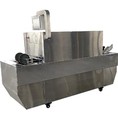
Tensile strength testing is a crucial procedure in various industries, including materials science, manufacturing, and quality control. It measures the maximum stress a material can withstand while being stretched or pulled before breaking. As a supplier of finishing test machines, a common question we often encounter is: Can a finishing test machine be used for tensile strength testing?
Understanding Finishing Test Machines
Finishing test machines are designed to evaluate the final properties and performance of materials after various finishing processes. These machines play a vital role in ensuring that the finished products meet the required quality standards. Our range of finishing test machines includes a variety of equipment, such as the Continuous Reduction Steam Bath Box, Hot Air Drying Oven, and Mini Dehydrator.


The Continuous Reduction Steam Bath Box is used for processes that require a controlled steam environment, such as the reduction of certain chemical compounds in textile finishing. The Hot Air Drying Oven is essential for drying materials at a specific temperature and humidity level, which is crucial for achieving the desired finish. The Mini Dehydrator, on the other hand, is a compact and efficient device for removing moisture from small samples.
Tensile Strength Testing Requirements
Tensile strength testing requires a machine that can apply a controlled and gradually increasing force to a test specimen until it breaks. The machine must be able to accurately measure the applied force and the resulting deformation of the specimen. Key components of a tensile testing machine include a load cell to measure the force, a crosshead that moves to apply the force, and a data acquisition system to record the test results.
The test specimen is typically prepared in a specific shape and size according to the relevant standards, such as ASTM (American Society for Testing and Materials) or ISO (International Organization for Standardization). During the test, the specimen is clamped at both ends, and the crosshead moves at a constant speed to apply the tensile force. The load cell measures the force, and the data acquisition system records the force and displacement values.
Can a Finishing Test Machine Be Adapted for Tensile Strength Testing?
The answer is not a straightforward yes or no. While some finishing test machines may have certain features that could potentially be adapted for tensile strength testing, it depends on several factors.
1. Force Application Capability
Tensile strength testing requires a machine that can apply a significant amount of force, depending on the strength of the material being tested. Some finishing test machines may not have the necessary force capacity to perform tensile tests on materials with high tensile strengths. For example, a machine designed for gentle finishing processes may not be able to generate the forces required to break a steel specimen.
2. Precision and Accuracy
Tensile strength testing requires high precision and accuracy in force measurement and displacement control. Finishing test machines may not have the same level of precision as dedicated tensile testing machines. The load cells and control systems in finishing test machines may be calibrated for different applications and may not provide the accurate measurements needed for tensile strength testing.
3. Specimen Clamping
Proper specimen clamping is crucial for accurate tensile strength testing. The clamping mechanism must be able to hold the specimen securely without causing any damage or slippage during the test. Finishing test machines may not have clamping mechanisms designed for tensile testing, which could lead to inaccurate test results.
4. Data Acquisition and Analysis
Tensile strength testing requires a data acquisition system that can record and analyze the force and displacement data. The system should be able to calculate important parameters such as the ultimate tensile strength, yield strength, and modulus of elasticity. Finishing test machines may not have the necessary software or hardware for this type of data analysis.
Potential Adaptations for Tensile Strength Testing
Despite the challenges, there may be some cases where a finishing test machine can be adapted for tensile strength testing.
1. Low - Strength Materials
For materials with relatively low tensile strengths, such as certain polymers or textiles, a finishing test machine with a suitable force capacity may be able to perform basic tensile strength testing. In these cases, the machine may need to be modified with a more accurate load cell and a proper clamping mechanism.
2. Research and Development
In a research and development setting, where approximate tensile strength data is sufficient, a finishing test machine can be used as a preliminary testing tool. This can help researchers quickly evaluate the general tensile properties of a material before conducting more accurate tests using a dedicated tensile testing machine.
Advantages of Using a Dedicated Tensile Testing Machine
While there may be some potential for adapting a finishing test machine for tensile strength testing, using a dedicated tensile testing machine offers several advantages.
1. Accuracy and Precision
Dedicated tensile testing machines are specifically designed for tensile strength testing and are calibrated to provide highly accurate and precise results. They have advanced load cells and control systems that can measure the force and displacement with a high degree of accuracy.
2. Compliance with Standards
Tensile strength testing is often subject to strict industry standards. Dedicated tensile testing machines are designed to meet these standards, ensuring that the test results are valid and comparable.
3. Versatility
Dedicated tensile testing machines can be used for a wide range of materials and test configurations. They can be equipped with different types of grips and fixtures to accommodate various specimen shapes and sizes.
Conclusion
In conclusion, while a finishing test machine may have some potential for being adapted for tensile strength testing, especially for low - strength materials or in a research and development context, it is generally recommended to use a dedicated tensile testing machine for accurate and reliable results. However, we understand that every situation is unique, and if you have specific requirements or are interested in exploring the possibility of using our finishing test machines for tensile strength testing, we are here to help.
As a supplier of finishing test machines, we are committed to providing high - quality products and excellent customer service. If you have any questions about our products, including the Continuous Reduction Steam Bath Box, Hot Air Drying Oven, or Mini Dehydrator, please feel free to contact us for a detailed discussion and to explore the best solutions for your testing needs. We are eager to engage in procurement discussions and look forward to the opportunity to serve you.