


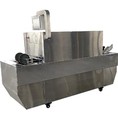
The production lead time in the textile industry is a critical factor that can significantly impact a company's competitiveness. Among the various elements influencing production lead time, the capacity of a fabric dyeing machine plays a pivotal role. As a supplier of capacity fabric dyeing machines, I have witnessed firsthand how different machine capacities can affect the overall production process. In this blog, I will delve into the relationship between the capacity of a fabric dyeing machine and production lead time, exploring both the advantages and challenges associated with different capacities.
Understanding Fabric Dyeing Machine Capacity
Before discussing the impact on production lead time, it's essential to understand what we mean by the capacity of a fabric dyeing machine. The capacity of a fabric dyeing machine refers to the maximum amount of fabric it can dye in a single batch. This capacity can vary widely, from small - scale machines designed for sample dyeing to large - scale industrial machines capable of handling hundreds of kilograms of fabric at once.
We offer a range of fabric dyeing machines with different capacities to meet the diverse needs of our customers. For instance, our Medium Sample Dyeing Machine is suitable for dyeing small samples of fabric, which is ideal for testing new color combinations or fabric types. On the other hand, our J - type Dyeing Machine and Fabric Dyeing Machine are designed for large - scale production, with higher capacities that can significantly increase the output per batch.
Impact of Low - Capacity Machines on Production Lead Time
Low - capacity fabric dyeing machines, such as the medium sample dyeing machine, have their own place in the textile industry. They are often used for research and development, quality control, and small - batch production. However, when it comes to large - scale production, low - capacity machines can significantly extend the production lead time.
Multiple Batches
Since low - capacity machines can only handle a small amount of fabric at a time, multiple batches are required to dye a large quantity of fabric. For example, if a customer orders 1000 kilograms of dyed fabric and the low - capacity machine can only handle 10 kilograms per batch, 100 batches are needed. Each batch requires time for loading, dyeing, and unloading the fabric. This not only increases the total processing time but also adds to the labor and energy costs associated with each batch.
Setup Time
In addition to the actual dyeing time, each batch also requires setup time. This includes preparing the dye solution, adjusting the machine settings, and ensuring the fabric is properly loaded. With multiple batches, the cumulative setup time can be substantial, further increasing the production lead time.
Advantages of High - Capacity Machines in Reducing Production Lead Time
High - capacity fabric dyeing machines, like our J - type and large - scale fabric dyeing machines, offer several advantages in terms of reducing production lead time.
Fewer Batches
High - capacity machines can handle a large amount of fabric in a single batch. For the same 1000 - kilogram order, a high - capacity machine that can handle 200 kilograms per batch would only require 5 batches. This significantly reduces the number of times the machine needs to be loaded, operated, and unloaded, thereby cutting down on the overall processing time.
Economies of Scale
Larger batches also allow for economies of scale in terms of setup time and energy consumption. The setup time for a high - capacity machine is relatively fixed regardless of the batch size. So, when a larger quantity of fabric is dyed in one batch, the setup time per unit of fabric is reduced. Similarly, energy consumption per unit of fabric is often lower for high - capacity machines as they can operate more efficiently with a larger load.
Challenges Associated with High - Capacity Machines
While high - capacity machines offer significant advantages in reducing production lead time, they also come with some challenges.

Higher Initial Investment
High - capacity fabric dyeing machines generally require a higher initial investment. This includes the cost of purchasing the machine, installation, and training of operators. For small - and medium - sized textile manufacturers, this upfront cost can be a significant barrier to adoption.
Flexibility
High - capacity machines are less flexible compared to low - capacity machines. They are designed for large - scale production, and if there is a sudden change in order quantity or fabric type, it can be more difficult to adjust the production process. For example, if a customer reduces the order quantity, a high - capacity machine may still need to operate at a certain minimum capacity, leading to inefficiencies.
Considerations for Choosing the Right Machine Capacity
When choosing a fabric dyeing machine, textile manufacturers need to consider several factors to balance the need for reducing production lead time with other business requirements.
Production Volume
The most important factor is the expected production volume. If a manufacturer has a large and consistent order volume, a high - capacity machine is likely to be more cost - effective and can significantly reduce production lead time. On the other hand, if the production volume is small or variable, a low - capacity machine may be a better choice.
Product Diversity
The diversity of products also plays a role. If a manufacturer produces a wide range of fabric types and colors, a combination of low - and high - capacity machines may be required. Low - capacity machines can be used for sample dyeing and small - batch production, while high - capacity machines can handle large - scale orders.
Conclusion
The capacity of a fabric dyeing machine has a profound impact on production lead time. Low - capacity machines are suitable for small - batch production and research purposes but can extend the lead time for large - scale orders. High - capacity machines, on the other hand, can significantly reduce production lead time through fewer batches and economies of scale, but they also come with higher initial investment and less flexibility.
As a supplier of capacity fabric dyeing machines, we understand the unique needs of each customer. We offer a comprehensive range of machines to help textile manufacturers optimize their production processes and reduce lead times. Whether you are a small - scale producer looking for a sample dyeing machine or a large - scale manufacturer in need of a high - capacity industrial machine, we can provide the right solution for you.
If you are interested in learning more about our fabric dyeing machines or would like to discuss your specific requirements, we encourage you to contact us for a detailed consultation. Our team of experts is ready to assist you in making the best choice for your business.

References
- Textile Dyeing Technology Handbook, various authors, [Publication details if available]
- Research papers on textile production efficiency and dyeing machine capacity, academic databases