

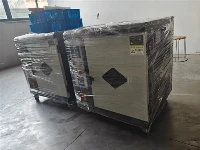


1. Distribution of fabrics - Arrange the blanks from the weaving factory according to the production plan of the dyeing factory, put the cloth into the cloth car and wait for subsequent processes. Function: ① Generally leave it for 12-24 hours to eliminate the tension during weaving and prevent dyeing spots caused by the tension of the gray cloth during dyeing. ②Open the unopened blank. For example, if you want to wash it with water, you can order different types of fabrics.
2. Water washing - mainly used for the process of OP cloth, which is completed by washing machine (also called scouring). Function: ①Remove oil, dirt and soil from fabrics. ②Relax fabric tension and internal stress.
3. Reservation - Since the fabric contains spandex, spandex is prone to shrinkage and storage creases and wrinkles during weaving. In addition, spandex has an oiling process during the production process. When dyeing, try to consider removing the oil. Through the reservation of the gray fabric, ① It can basically eliminate storage creases and wrinkles ② The oil inside the fabric is evaporated to the surface of the fabric through a predetermined high temperature, and the oil is better removed through pre-scouring. ③ Eliminate the edge retraction of spandex cloth and improve the quality of pre-finishing dyeing.
4. Refining - polyester elastic knitted fabrics, due to uneven stress during processing, often have creases and wrinkles caused by spandex shrinkage. It is necessary to release the fabric tension and relax and shrink. However, since there is no relaxation machine, only Can be refined and relaxed in the dye vat. Since it is refined in the dye vat and the dyeing machine has a certain tension, it cannot ensure that the fabric shrinks evenly under tension-free conditions, so when processing spandex knitting, more abnormalities occur.
5. Dyeing – the main points include the following:
①. Pick up materials - feed water - chemical materials - add additives - feed materials - adjust the heating curve
②. Common exceptions:
A. Poor operation and knotting in dyeing can easily produce serious stains.
B. The temperature rises too fast, and the coloring is done too quickly in a short period of time. The heat preservation time is not enough, and the leveling time is not enough.
C. High hardness in a certain period due to water supply.
D. Improper pH adjustment, especially when using high-fastness dyes to make ultra-fine OP-containing fabrics, color blooms or color differences are likely to occur.
E. The color formula has poor compatibility. The dye has poor stability and reproducibility at high temperatures, and is prone to color blooming or color difference.
F. When the dyeing vat changes hue, the vat is not cleaned properly, resulting in oil stains or lumpy color flowers on the cloth surface during dyeing.
G. The size of the nozzle is not suitable, and it is easy to produce striped colored flowers.
H. The gray cloth contains a lot of oil, and the oil is not clean. When dyeing, it is easy to produce colored flowers in the areas where the oil is not clean.
1. The dyeing tank capacity is too large or the cloth in the tank is too long.
J. The dyeing speed is too slow.
K. The effectiveness of the auxiliaries used in dyeing is unstable or the compatibility between the dye factors and the auxiliaries is poor.
L. The relaxation and refining efficiency is poor.
M. The dyeing tank capacity is too large.
N. The dyeing machine is not operating normally.
U. When dyeing, the cooling speed is too fast, so that the cloth surface directly enters the cold water state from high temperature to form small horizontal wrinkles.
V. The nozzle selection is unreasonable.
W. The dye transfer property is poor.
X. During dyeing, the temperature rises too fast during the dyeing stage, and the tension of the dyed gray fabric is too high (this means that the nozzle pressure and the belt wheel speed adjustment do not match, causing the line speed to be too fast, and the fabric tension becomes larger). Folding, and the color at the crease is different from the color of other parts.
6. Cutting samples and matching colors - correcting colors to make them meet customer requirements.
7. dehydration
① Try to dehydrate as soon as possible after dyeing, because the weight of the OP-containing cloth increases when it is filled with water, and it is easy to produce backlog creases and wrinkles.
② The inside of the dehydration machine cage should be clean to prevent staining and snagging.
③When dehydrating, be careful not to take too long and not too much dehydrated fabric. Otherwise, it will cause a large number of "color flowers" on the surface of the fabric due to excessive dehydration.
8. Neutral setting reduction washing - After neutralizing, the dye in the unset area of the fiber can be sublimated to the surface of the fabric through high temperature. After entering the tank and reducing washing, the dye stained on the fiber surface can be removed. To achieve the purpose of improving color fastness. Another purpose is to make the width and weight of the door.
9. Reduction washing - the purpose of post-processing is to remove floating colors on the surface of the fabric, thereby improving the fabric's rubbing fastness, washing fastness, sublimation fastness and dye migration fastness.
10. settled
① The filter of the setting machine should be cleaned regularly and the temperature in each box should be adjusted reasonably to prevent the temperature difference in the oven from being too large and causing unevenness.
② The pressure on the left and right sides of the shaping water rolling press should be controlled to be the same to prevent the difference in left and right pressure from causing unevenness.
③ The process standards for shaping air volume must be set and followed to prevent unevenness caused by improper air volume adjustment.